### Help your Agent accumulate experience, so people can focus on creation.
[](https://www.npmjs.com/package/@tencentdb-agent-memory/memory-tencentdb)
[](./LICENSE)
[](https://nodejs.org/)
[](https://github.com/openclaw/openclaw)

[](https://discord.gg/kDtHb5RW2)
[Highlights](#-highlights) · [Overview](#overview) · [Core Technology](#core-technology-reject-flat-storage-embrace-layering-and-symbolization) · [Quick Start](#quick-start)
---
## ✨ Highlights
> **TencentDB Agent Memory = Symbolic short-term memory + Layered long-term memory.**
>
> - **Symbolic short-term memory**: offload heavy tool logs layer by layer and progressively condense them into lightweight Mermaid structural symbols, drastically reducing token consumption while improving task success rate.
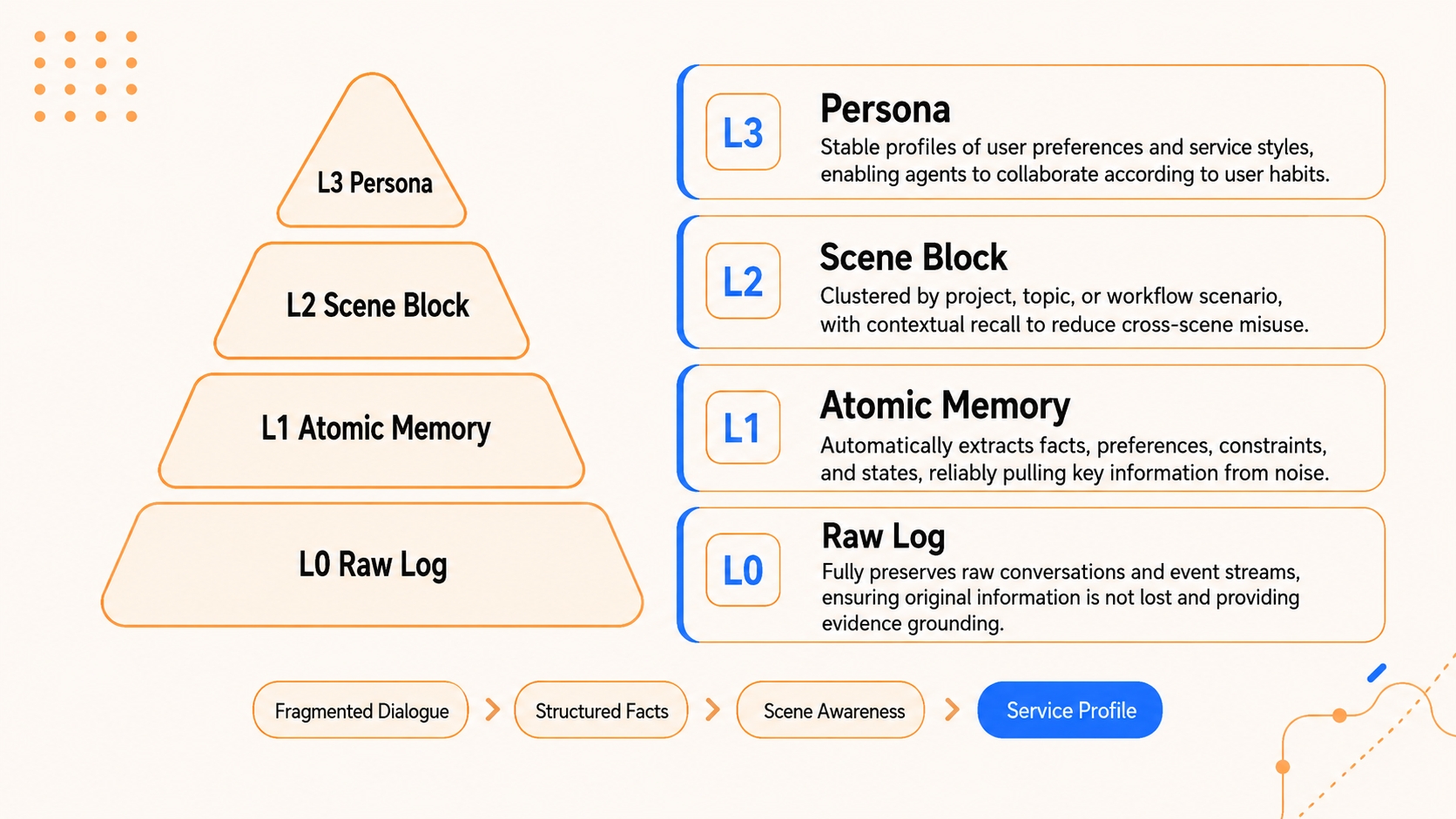
> - **Layered long-term memory**: refine fragmented conversations layer by layer into structured personas and scenes — no more flat vector piles.
**Plugged into OpenClaw**, it saves up to **61.38% tokens**, lifts pass rate by **+51.52%** (relative), and pushes PersonaMem accuracy from **48%** to **76%**.
| Memory Capability | Benchmark | Openclaw Success | With Plugin | Relative Δ | Openclaw Tokens | With Plugin Tokens | Relative Δ |
| :--- | :--- | :---: | :---: | :---: | :---: | :---: | :---: |
| **Short-term** | WideSearch | 33% | **50%** | **+51.52%** | 221.31M | **85.64M** | **−61.38%** |
| **Short-term** | SWE-bench | 58.4% | **64.2%** | **+9.93%** | 3474.1M | **2375.4M** | **−33.09%** |
| **Short-term** | AA-LCR | 44.0% | **47.5%** | **+7.95%** | 112.0M | **77.3M** | **−30.98%** |
| **Long-term** | PersonaMem | 48% | **76%** | **+59%** | — | — | — |
> These are long-session evaluations, not single-turn isolated runs. Multiple tasks are concatenated into the same session and executed back-to-back. For example, each SWE-bench session runs 50 tasks consecutively to simulate the context-accumulation pressure faced by a real long-horizon Agent.
---
## Overview
**Memory is not about letting AI store everything — it is about freeing humans from repeating everything.**
In real work, we often have to repeatedly tell the Agent about fixed SOPs, project backgrounds, tool habits, and output formats. This information should not need to be re-explained every time, yet it also should not be mindlessly and flatly crammed into the context.
TencentDB Agent Memory helps the Agent learn your workflows, retain task context, and reuse past experience. But we **reject brute-force history piling** and **abandon irreversible brute-force summarization**. We design memory as a deeply layered system: **symbolic memory** to solve information overload within a single long task, and **memory layering** to solve cross-session experience accumulation.
> **Let the Agent remember what should be remembered, so people can focus on judgment, creation, and work that truly matters.**
---
## Core Technology: Reject Flat Storage, Embrace Layering and Symbolization
The design philosophy of TencentDB Agent Memory revolves around two cores: **memory layering** and **symbolic memory**. This not only lets the Agent "remember more" but, more importantly, "think more clearly".
### 1. Memory Layering: Progressive Disclosure and Heterogeneous Storage
Traditional memory systems often slice all data into flat vectors. Recall then feels like searching for clues among a pile of unrelated sticky notes, lacking the guidance of a macro perspective.
We believe that **whether it is long-term knowledge, short-term tasks, or future experiential capabilities, memory should never be flat — both generation and recall must have layers**. TencentDB Agent Memory adopts "layering" as the unified design philosophy across the entire architecture:
* **Short-term memory (context offload / task) layering**: the bottom layer retains the raw, heavy tool-call results (`refs/*.md`); the middle layer extracts step summaries (`jsonl`); the top layer condenses everything into an extremely lightweight Mermaid task canvas. The Agent only needs to focus on the top-layer structure in the context, drilling down to the bottom layer via `node_id` when errors occur.
* **Long-term personalization (user understanding) layering**: break away from flat history logs and build a semantic pyramid: L0 raw conversations → L1 structured facts → L2 scene blocks → L3 user persona. Rely on the top-layer persona to grasp user preferences day-to-day; search the bottom-layer facts when details need verification.
* **Skill generation (skill and action accumulation, Roadmap) layering**: memory should not be limited to "knowing what" but also include "knowing how". We are extending layering into the action domain: from bottom-layer execution traces and error logs, the middle layer generalizes common solution patterns, and the top layer ultimately distills reusable Skills or standardized SOP code.